Our targets and outcomes during the years 2020 to 2025 when our sustainability efforts was guided by specific goals linked to ten areas.
Contact us
Sending Email...
Contact person/s

Glenn Svedberg
Group Sustainability & Technology Director

SUSTAINABLE DEVELOPMENT
Nolato's sustainable targets 2020-2025
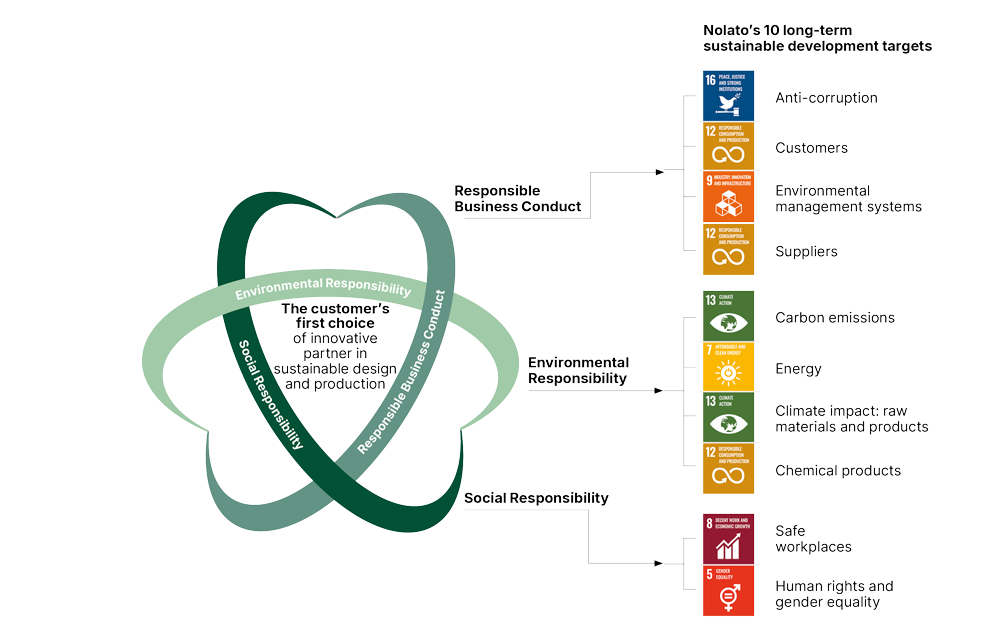
During the years 2020 to 2025, Nolato's sustainability efforts was guided by specific goals linked to ten areas. Together, these goals encompass the sustainability issues that have been most critical for the group. However, as the world changes, the priority areas for our sustainability work have also evolved. As we establish new sustainability goals 2026, that will shape our efforts over the next five-year period, we present here our progress to 2025.
Nolato - purposeful work during the years 2020 to 2025
The UN presented its Sustainable Development Goals (SDGs) in 2017, as part of its 2030 Agenda for Sustainable Development. The 17 goals provided a clear and useful framework for addressing global challenges, and they have had a huge impact on society. Businesses are expected to contribute by adopting responsible business practices, providing transparent reporting of their own targets and outcomes and developing products and services that foster sustainable development. The UN Sustainable Development Goals helped Nolato identifying key areas within sustainable development, and the Group highlighted ten targets that are clearly was relevant to our business. With these targets as a starting point, Nolato could see opportunities to reduce our environmental impact and create business opportunities.
Minimizing Nolato’s use of resources and its carbon footprint was during 2020-2025 key to achieve our targets. We accomplish this by working with innovation, efficiency improvements, investments in new technology, greater use of renewable energy, and initiatives focusing on bio-based and recycled plastics. The UN Sustainable Development Goals also provided inspiration for measures on social responsibility, social engagement and business ethics.
Social responsibility
Nolato has a long-standing tradition of taking responsibility and creating value for society. Value creation is found particularly in the number of jobs we generate via our global operations, and the sustainable solutions we offer our customers, but also in the active engagement we pursue in the local communities in which we have a presence. Our value creation is built on our responsibility, which is also one of the Basic Principles detailed in The Nolato Spirit. Applying sound business ethics, protecting our employees’ safety and respecting human rights makes us a good employer, a responsive cooperation partner and a considerate corporate citizen.
Safe workplaces
TARGET
- No-one should be injured at work, and the number of workplace accidents must be minimized.
MEASURES TO ACHIEVE TARGET
- Systematic and preventive safety work with relevant and regular training.
- Systems for registering and managing near misses should be in place at all units.
OUTCOME IN 2020-2025
The frequency of workplace accidents during the period has increased slightly since 2020. The outcome in 2025 was 6.1 workplace accidents (and/or cases of work-related ill health) per million hours worked, resulting in absences, compared to 5.2 in the 2020 base year.
In 2025, incident reporting systems were in place at 100% of the units (89% in 2020), and certified occupational health and safety management systems were in place at 33% of the units compared with 27% in the 2020 base year.
Human rights and gender equality
TARGET
- There should be no cases of infringements of human rights, discrimination or forced labor.
- The proportion of women in management positions should increase at all levels of Nolato.
- Nolato should be regarded as an attractive employer.
MEASURES TO ACHIEVE TARGET
- Zero tolerance of all forms of discrimination and harassment. No infringement of human rights or cases of child or forced labor are permitted. Code of Conduct training for all employees. Information about Nolato’s values, corporate culture and Code of Conduct are part of the onboarding process for all employees.
- Female candidates should be prioritized for management appointments in cases of equal skills and suitability.
- Continual provision of information to employees via various channels, such as quarterly or departmental meetings, staff newsletters and intranet. Training for employees’ personal development. Prioritization of in-house recruitment for new positions.
OUTCOME IN 2020-2025
No cases of human rights violations were reported during 2020–2025.
Women made up 27% of local management teams, of which 2 (2) subsidiaries have a female managing director. The proportion of women in local management teams was also 27% in the base year of 2020.
Environmental responsibility
Being a responsible company essentially means that we take responsibility for how our entire business affects our operating environment, both now and in the future. It starts with how economical we are with our use of resources, so that our operations and production are conducted with the minimum possible negative impact on the environment. With this as our foundation, we can make a positive contribution to our customers’ environmental impact, by offering advice and suggestions and, at times, challenging the customer to adopt new approaches in an effort to identify the most eco-friendly solution.
Energy
TARGET
- More efficient energy use; by 2025 usage should decrease by 55% compared with the average for 2011–2012 (GWh/net sales SEK).
MEASURES TO ACHIEVE TARGET
- Continued investment in more energy-efficient production equipment, infrastructure and lighting. Increased automation could mean higher electricity consumption in the longer term.
OUTCOME IN 2020-2025
Nolato’s energy consumption in relation to sales (GWh/net sales SEKm) has decreased by 53.4% compared to the average for 2011–2012. The outcome for 2025 was 0.021 GWh/SEKm compared to the average for 2011–2012, which was 0.045 GWh/ SEKm.
Greenhouse GAS emissions
TARGET
- Greenhouse gas emissions from energy consumption (Scope 1 and 2) are to be reduced by 80% by 2025, compared with the average for 2011–2012 (tons CO2e/net sales SEK).
MEASURES TO ACHIEVE TARGET
- More efficient use of energy, installing heat pumps, procuring fossil-free electricity, installation of own solar panels, contracts with solar farms, and phasing out fossil fuels.
OUTCOME IN 2020-2025
Nolato’s greenhouse gas emissions from energy consumption in relation to sales (Scope 1 & 2/net sales SEKm) have decreased by 98.9% compared to the average for 2011–2012. The outcome for 2025 was 0.2 tons of CO2e/SEKm compared to the average for 2011–2012, which was 17.3 tons of CO2e/SEKm.
Chemical products
TARGET
- Hazardous chemical substances should be identified and, where possible, phased out.
MEASURES TO ACHIEVE TARGET
- A number of chemical substances have been identified as candidates to be phased out. Continued measures for the safe handling of chemical products are being implemented.
OUTCOME IN 2020-2025
Use of hazardous chemical substances at Nolato is minimal, although there are a few risk reduction candidates. Approximately 170 different chemicals have been replaced or phased out during
2020–2025.
Climate impact: raw materials and products
TARGET
- There should be an increase in the percentage of bio-based and recycled raw materials. Greenhouse gas emissions related to products (Scope 3) should be reduced by 5% between 2020 and 2025 (tons/net sales).
MEASURES TO ACHIEVE TARGET
- The carbon footprint of products is being reduced through greater use of bio-based and recycled raw materials, together with designs that contribute to a circular economy. Nolato aims to be at the forefront of sustainability projects with customers and other stakeholders.
OUTCOME IN 2020-2025
The percentage of recycled, bio-based, mass-balanced materials doubled to 3.5% of total raw material consumption in 2025 from 1.7% in 2020.
Scope 3 emissions in relation to sales fell by 19% to 31.4 tons CO2e/SEKm in 2025 from 38.3 tons CO2e/SEKm in 2021. (Scope 3 emissions have not been calculated for base year 2020).
ENVIRONMENTAL MANAGEMENT SYSTEMS
TARGET
- All units to be ISO14001-certified.
MEASURES TO ACHIEVE TARGET
- Acquired companies are to be certified within two years.
OUTCOME IN 2020-2025
93% of the Group’s manufacturing units are ISO14001-certified in 2025, compared with 91% in 2020. During these years, several manufacturing units were added in the Group, most of which were
certified during this period.
Responsible business conduct
At Nolato, responsible business conduct means that we take responsibility for our business by setting clear requirements for our operations and those of our suppliers. This is firmly rooted in our corporate culture, in which our Code of Conduct serves as the Group’s ethical compass, setting the direction for our conduct both within our organization and in our relationships with stakeholders. By acting consistently based on our values, we create confidence, making us a reliable partner that our customers can trust and want to involve in their development projects and their journey to greater sustainability.

Anti-corruption
TARGET
- Ensure training of employees in the Code of Conduct and anti-corruption measures. There should be no cases of bribery, corruption or cartel formation.
MEASURES TO ACHIEVE TARGET
- Use of preventive procedures and the Code of Conduct, as well as monitoring of compliance. Training in the Code of Conduct and anti-corruption measures. Information about Nolato’s values, corporate culture and Code of Conduct are part of the onboarding process for all new employees. Application of the whistleblower system throughout the Group.
OUTCOME IN 2020-2025
The annual evaluations of Group companies’ anti-corruption measures show a high level of ambition. The Nolato Spirit and Code of Conduct are a training requirement for all new employees in the onboarding process, and for all employees every three years.
No incidents related to corruption or deficient business ethics were reported during the period. Business partners in risk zones are continually analyzed as needed, in response to new restrictions. The Group’s policy on trade sanctions is regularly updated.
Customers
TARGET
- Nolato aims to maintain a leading position and be perceived as the customer’s first choice within sustainable development.
MEASURES TO ACHIEVE TARGET
- Trends and customer requirements within sustainable development should be identified and, where relevant, turned into practical measures. The overriding aim is to exceed customer expectations. Annual survey of customer satisfaction regarding customers’ perception of the company’s products and services, as well as future expectations.
OUTCOME IN 2020-2025
The number of dialogs with customers on reducing climate impact and using renewable or recycled raw materials continued to rise during the period. The number of customer meetings in 2025 about solutions and alternatives that support sustainable development increased.
Professional development and use of digital tools to simulate products’ function and performance have helped to optimize the products’ use of resources and enabled circular flows. Besides, product carbon footprint calculations have been launched, providing guidance when choosing alternative solutions and materials with respect to carbon footprint.
Nolato was awarded a gold medal by EcoVadis and recognized as a European Climate Leader in both 2024 and 2025 by the Financial Times and Statista. Nolato was ranked in third position in Dagens Industri’s list of Sweden’s most sustainable companies in 2024. Nolato had the overall score of B in CDP Climate Change 2025.
Suppliers
TARGET
- By 2025, all strategic suppliers will be assessed according to Nolato’s guidelines for suppliers.
MEASURES TO ACHIEVE TARGET
- Assessment of Nolato’s strategic suppliers using an extensive questionnaire on management systems and sustainability.
OUTCOME IN 2020-2025
At the end of 2025, Nolato had 721 key suppliers. Of these, 586 had been evaluated according to Nolato’s supply chain due diligence process and approved Nolato’s Supplier Code of Conduct, representing 81% of all key suppliers. During the period, it was decided to cease cooperation with a number of suppliers because they did not fulfill Nolato’s requirements.